What if the choices we make today could rewrite the future?
What if…

Play a role; rewrite the future today.
Come along to the Wardlaw museum to…

Rewrite the Characters
Who are the main characters in the story of our future? And who should they be?
What if we listened to refugee tales?
At present refugees can be imprisoned without a time limit. Around 24,000 people a year are detained simply for seeking asylum. Most have broken no laws. One has been locked up for nine years.
Refugee Tales seeks to listen to the experiences of refugees and people seeking asylum. The evidence they gather has led them to call for a 28-day limit to detention, improved conditions, and a more humane, rights-based approach to asylum.

Rewrite the Setting
What will be the setting for the story of our future? And how will it change?
What if our towns were real urban jungles?
Cement is currently vital to how we build our towns and cities, but its production creates more carbon dioxide each year than air travel.
But cement isn’t the only option. Architects, engineers and ecologists are working together to explore how living materials could offer low-carbon alternatives. Our buildings would look very different, but they would help to improve air quality, reduce urban heat and enhance biodiversity.
In prototypes like this one algae, rather than cement, holds building materials in place.
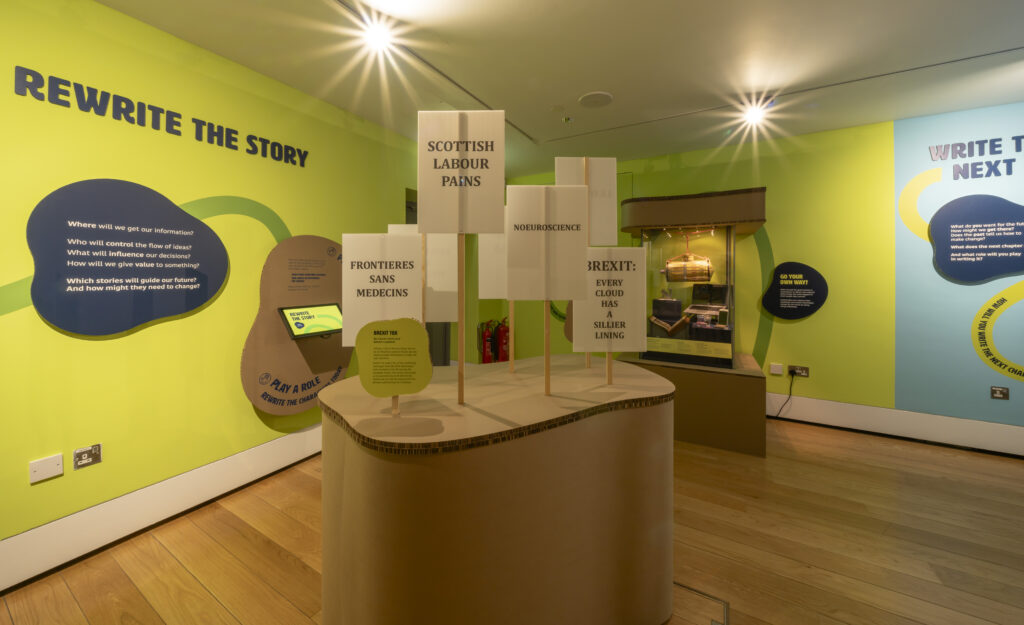
Rewrite the Story
Which stories will guide our future? And how might they need to change?
What if communities took meaningful control?
Often we wait for governments or corporations to deliver new ways of doing things. But what if grassroots organisations led the way?
Some of the poorest people in Colombia are revolutionising the way we deal with a major source of pollution. Waste-pickers run factories that turn plastic into useful, recycled objects. Even the Ecuadorian Ambassador to the UK uses one of their laptop stands.
Instead of being run by big businesses, the plastic pickers have taken control and are now advising the government.
Write the Next Chapter
What does the next chapter say? And what role will you play in writing it?